_REV.webp)
How to Decrease Creative Turnaround Time | Growth Marketing Case Study
By Anna Stallmeyer
Senior Project Manager
Connect with me on LinkedIn
Today’s fast-moving digital landscape requires brands to produce more content in less time to remain visible on the market. Companies need speedy, optimized content development that balances business goals and delivers high-quality creative. Yet, many organizations don’t realize that the biggest barrier to this is the time lost in creative production due to inefficient workflows - something that becomes clear only when they see the difference.
Why creative workflows stall campaigns
Long idea-to-delivery timelines are not driven by creative complexity, but by outdated and unstructured processes.
Inefficiencies are hidden in plain sight, stemming from:
· unclear feedback loops,
· fragmented review processes,
· endless approval cycles,
· lack of cross-team collaboration, and
· siloed communication.
Accumulated, these bottlenecks result in higher days-per-creative piece, slow time-to-market, and consequently increased costs and lost opportunities. When this happens, the value of a more structured system becomes undeniable.
How to improve your creative production workflow
Recognizing the impact of inefficient workflows, organizations can adopt a streamlined creative development system that delivers measurable improvements across speed, clarity, and quality. This system is built on the following operational principles:
· Translate strategy effectively – start with a clear, detailed, templated creative brief that speaks the creative team’s language and sets accurate expectations.
· Align at kick-off – conduct a kick-off session to ensure understanding of the brief and align on deliverables and timelines
· Centralize project management – maintain cross-functional alignment through regular follow-ups and transparent action items
· Structure the review process – prevent repeated feedback cycles by consolidating reviews and defining what aspect requires input at each stage
· Apply Agile workflows – use short, iterative phases to identify deviations early and adjust before issues escalate
· Plan team’s capacity – proactively manage workload to avoid bottlenecks and maintain consistent output quality
· Measure and optimize – monitor turnaround times, delays and their impact on deliverables to continuously refine the process
Streamlined creative production in action
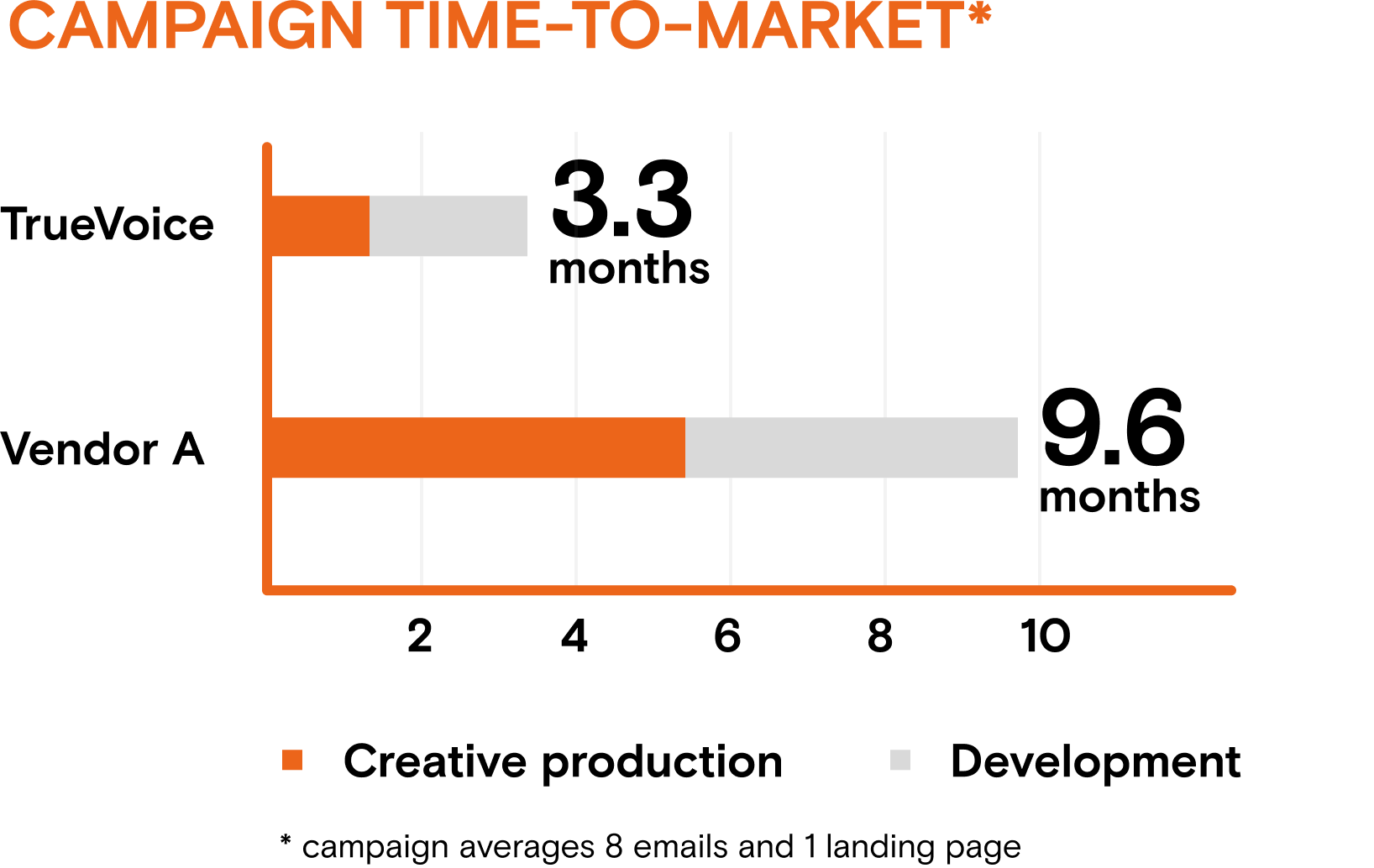
A recent client experienced exactly this “slow execution” reality when working with a third-party vendor. Each creative piece took over two weeks from concept to approval meaning that producing a full campaign of eight emails and one landing page would have taken more than nine months under the existing workflow.
Third-party vendor time to complete
· Creative production (one unit): 16.22 days
· Total production time (8 emails, 1 landing page): 162.2 days
· Development (one unit): 13.04 days
· Total development time (8 emails, 1 landing page): 130.4 days
Overall campaign time-to-market: 292.6 days (9.6 months)
TrueVoice time to complete
· Creative production (one unit): 4.04 days
· Total production time (8 emails, 1 landing page): 40.4 days
· Development (one unit): 6.39 days
· Total development time (8 emails, 1 landing page): 60.39 days
Overall campaign time-to-market: 100.79 days (3.3 months)

Applying our guiding principles as a growth marketing agency, we analyzed the existing processes and recommended implementing the following structures to achieve stronger, more predictable creative outcomes:
· Strategic opening sessions – integrating stakeholder insights early ensures clarity and alignment from the start.
· Iterative and incremental delivery – producing smaller, frequent outputs ensures alignment with brand objectives and reduces the risk of major rework.
· Structured, consolidated feedback loops – emphasizing focused review and approval cycles help adjust priorities, change direction, or catch issues early.
· Close cross-functional collaboration – establishing regular team check-ins improve processes, break down silos, and increase accountability and involvement.
· Ongoing client involvement – validating and refining deliverables with end-user expertise minimizes the likelihood of late-stage revisions.
Partnering with the client to bring these solutions to life we delivered a comparable project in a third of the time. This represents a 65% acceleration in time-to-market achieved through optimized workflows, agile processes, and streamlined communication. The improvement came not from increased effort, but from improved execution.
A 65% acceleration not only translates into faster go-to-market for campaigns, but also results in
· Stronger alignment across internal and external teams
· More room for creative exploration
· Higher volume of content delivered
· Better budget efficiency
How operationalized creative production gives brands a competitive edge
TrueVoice goes beyond being just a creative producer, we act as an operational partner who gives the clients a competitive advantage through the ability to execute quickly and consistently. A proven, scalable process allows our clients to work smarter. By replacing fragmented workflows with predictable, integrated processes, our results demonstrated how the right partnership can unlock speed, clarity, and high-quality deliverables. Our client is now better positioned to respond faster to audience needs, competitive shifts, and seasonal opportunities without sacrificing quality.
Want more insights on streamlining your production workflows?
To learn how to accelerate delivery and improve operational efficiency, schedule a session with us today. Together, we’ll build a foundation for smoother processes, faster turnarounds, and stronger results.

.webp)